
In precision manufacturing, one of the most dangerous situations is when a part appears completely acceptable — yet still fails inspection or assembly. The dimensions look close. The surface finish looks good. The machining process seems successful.But when the part reaches CMM inspection or final assembly, it gets rejected immediately.This problem happens more often than many people realize in CNC machining and die casting projects. And in most cases, the issue is not the machining itself — it is the misunderstanding of datum relationships and functional tolerancing. For manufacturers and product developers, understanding this difference is critical to avoiding assembly failures, costly rework, and production delays.
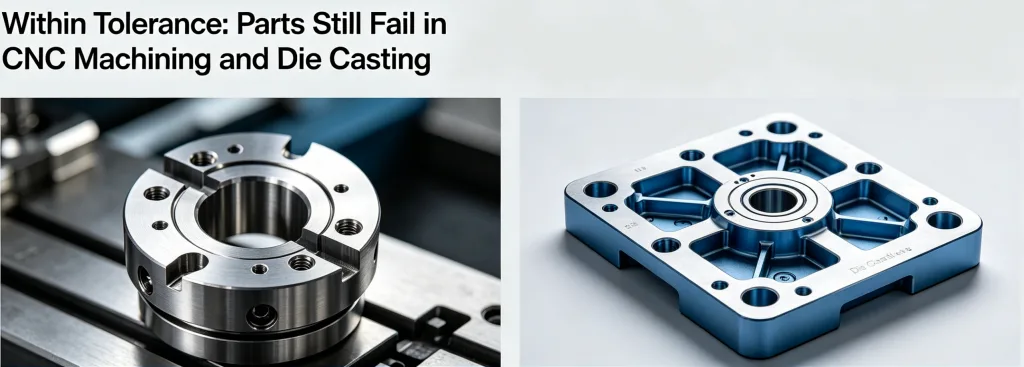
The Part Looked Perfect — But CMM Rejected It
A common example involves a machined component with negative tolerance applied on both outer edges. A programmer reviewed the drawing and assumed the profile could be shifted slightly during machining to simplify setup and maintain overall dimensions. At first glance, the logic seemed reasonable because the finished size still remained “within tolerance.”However, one critical hole feature was dimensioned from datum A on the left side of the drawing. That changed everything.Although the outer profile could shift within tolerance, the datum-controlled hole location could not move freely. Once the machining offset was applied globally, the hole position drifted relative to the datum structure.
After machining:
-The overall size appeared acceptable
-The part visually looked correct
-Standard dimensional checks seemed close
But the functional relationship between the datum and the hole was already broken. The CMM detected the positional deviation immediately.This is one of the most common reasons why parts that “look good” still fail precision inspection.
The Real Problem: Datum Logic Was Broken
Engineering drawings are not simply collections of dimensions. They define functional relationships between features.When a feature is controlled by a datum reference, that relationship becomes the foundation of the entire part’s functionality. A machining team cannot simply redistribute tolerances for convenience without understanding how those features interact during assembly. In this case, the mistake was not the dimension itself. The mistake was ignoring the datum intent behind the dimension. This is where many manufacturing problems begin. A part may still fall within general dimensional limits while simultaneously violating its functional geometry.That is why experienced manufacturers focus not only on dimensions, but also on:
-datum structure
-feature relationships
-tolerance stack-up
-assembly alignment
-inspection logic
Without that understanding, machining becomes guesswork instead of controlled engineering.
Why This Happens Frequently in Die Casting & CNC Projects
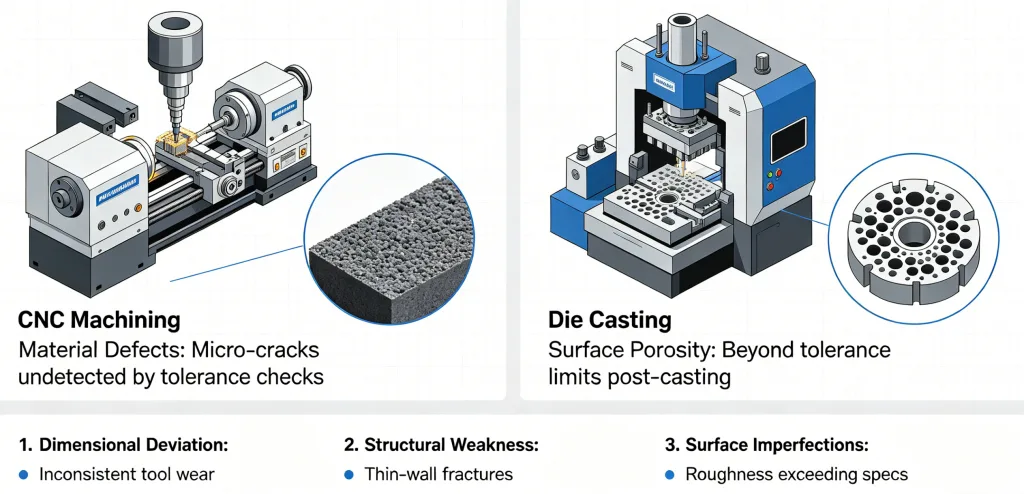
This issue is especially common in die casting and secondary CNC machining projects because multiple manufacturing stages affect the final geometry of the part. For example, die cast components naturally experience: material shrinkage, thermal distortion, minor warpage, casting variation.
After casting, the part often undergoes secondary CNC machining operations where fixtures and locating surfaces become critically important.If the machining fixture references a different surface than the drawing datum, positional features such as holes, slots, or assembly faces may shift unintentionally. This can create problems like:
- hole misalignment
- assembly interference
- poor sealing surfaces
- inconsistent fitment
- failed positional tolerances
In many cases, the casting itself is acceptable, and the machining dimensions may appear correct individually. But once the datum relationship changes between operations, the final part no longer functions properly in the assembly.This is why datum strategy is so important in precision die casting manufacturing.
Why CMM Inspection Matters
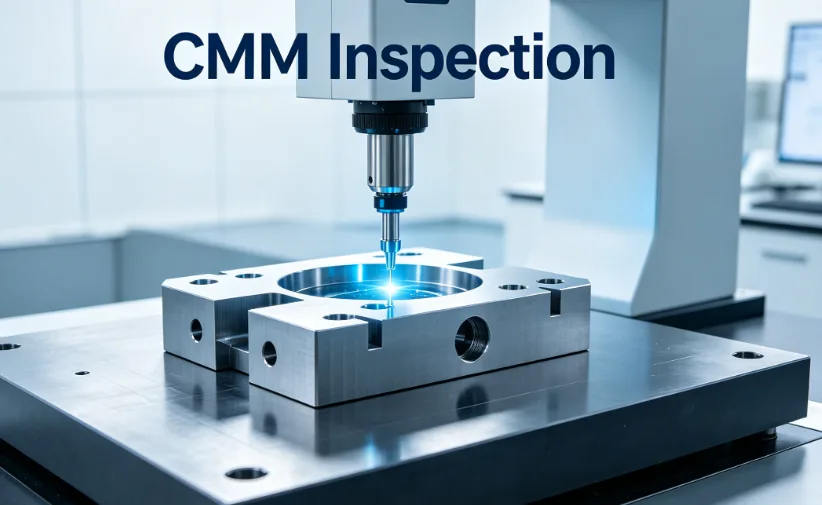
Visual inspection alone is not enough for precision components. A part can appear perfectly machined while still containing critical geometric errors that affect assembly performance. Even standard tools such as calipers or micrometers cannot fully evaluate complex datum relationships or positional tolerances. This is where CMM inspection becomes essential.
Coordinate Measuring Machine (CMM) systems analyze the part based on the datum structure defined in the engineering drawing. Instead of checking isolated dimensions independently, CMM inspection evaluates how all features relate to each other functionally. This allows manufacturers to detect issues such as:
- positional drift
- true position errors
- perpendicularity deviation
- datum misalignment
- geometric instability
For precision CNC machining and die casting projects, CMM inspection is not simply about quality control — it is about verifying real functional accuracy.
How Professional Manufacturers Prevent This
Reliable manufacturing requires more than simply machining parts to nominal dimensions. Professional suppliers reduce production risk by analyzing the entire manufacturing process before machining even begins. This typically includes:
DFM Review
Engineering teams review the drawing to identify potential tolerance conflicts, machining risks, and assembly concerns before production.
GD&T Analysis
Manufacturers evaluate datum structure, positional tolerances, and functional relationships to ensure the machining strategy matches the design intent.
Fixture Strategy
Proper fixture design ensures that machining references align with the drawing datums throughout every operation.
CMM Inspection
Critical dimensions and geometric relationships are verified using datum-based inspection methods instead of visual judgment alone.
Process Control
Stable machining processes reduce variation between batches and maintain consistency during production.
Engineering Communication
Experienced suppliers communicate with customers early when drawings contain ambiguous tolerances or manufacturability concerns. This engineering-focused approach helps prevent costly failures before they reach assembly.
Precision Manufacturing Is About Function — Not Just Dimensions
In modern CNC machining and die casting, successful manufacturing is not only about producing parts that measure “close enough.” It is about producing parts that function correctly in real-world assemblies. A component may technically fall within dimensional tolerance while still failing because its datum relationships, positional geometry, or assembly alignment were misunderstood during manufacturing.
That is why experienced manufacturers focus on the entire engineering logic behind the drawing — not just individual numbers. A reliable manufacturing partner should not only machine parts to size, but also understand how those parts are supposed to function in real assemblies.