

How can you ensure that your metal products or coated components won’t rust or fail prematurely when exposed to humid, salt-laden air? Which corrosion testing method should you choose to quickly and accurately predict potential issues? The salt spray test offers a standardized solution to this challenge. However, among the three mainstream methods—NSS, AASS, and CASS—the correct choice is crucial. The new GB/T 10125-2021 standard not only clarifies their applicable scopes but also enhances testing purity and standardization, guiding enterprises to make scientific decisions and ensuring product durability in global markets.
What Is a Salt Spray Test?
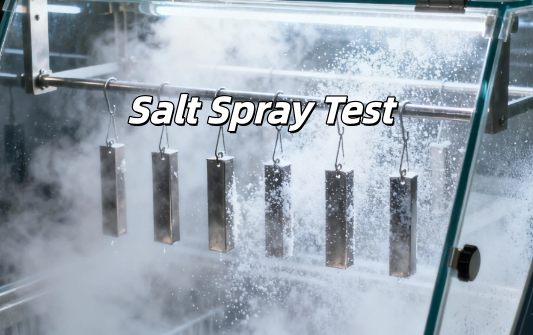
The salt spray test is an accelerated corrosion testing method that uses atomized saltwater solutions to simulate marine or atmospheric corrosion environments. It is designed to evaluate the corrosion resistance of materials and their surface coatings.
Advantages of Salt Spray Test
Enhancing Corrosion Protection and Global Compatibility
The new standard provides a scientific basis for evaluating corrosion resistance, helping companies identify weak points in design or manufacturing, improve coating formulas, or optimize plating processes.
Since GB/T 10125-2021 is technically equivalent to ISO 9227:2017, test results are internationally comparable—benefiting global certification and export.
Promoting Standardization and Export Certification
The new standard promotes unified, upgraded testing methods across industries, addressing inconsistency caused by varied test conditions.
Industries can directly adopt GB/T 10125-2021 as a unified quality evaluation system.
For export products, test results based on the new GB standard are equivalent to ISO results, reducing technical trade barriers.
Applications of Salt Spray Testing in Different Industries
Salt spray testing is fast, standardized, and cost-effective, making it widely used across industries:
Metals and Electroplating
Metal manufacturers and electroplating companies use salt spray tests to evaluate base metal and coating corrosion resistance.
For example, decorative chromium-plated parts typically require CASS testing for dozens of hours with no substrate corrosion.
The new standard’s clarified scope for AASS and CASS improves the reliability of electroplating assessments.
Automotive Parts and Coating Industry
Automotive components (such as body panels and fasteners) and protective coatings are tested to ensure durability.
Coating manufacturers use salt spray testing to evaluate protection at scratch sites and detect defects such as poor adhesion or pinholes.
Automotive standards often require zinc-plated bolts to withstand ≥48 hours NSS testing with no red rust.
The updated GB/T 10125-2021 aligns with international standards, facilitating consistent global corrosion performance evaluation.
Salt Spray Test Usage by Industry (Estimated Share)
- Automotive and parts: 35%
- Electronics and electrical: 20%
- Construction hardware: 15%
- Marine and offshore engineering: 12%
- Aerospace: 8%
- Other industries: 10%
Three Standard Types of Salt Spray Tests
The standard specifies three types of salt spray test methods:
- NSS, AASS, and CASS
Neutral Salt Spray Test (NSS):
Uses a 5% sodium chloride neutral solution at 35°C ± 2°C, with a pH value of 6.5–7.2.
Acetic Acid Salt Spray Test (AASS):
Uses a 5% sodium chloride solution with added glacial acetic acid at 35°C ± 2°C, with a pH value of 3.1–3.3.
Copper-Accelerated Acetic Acid Salt Spray Test (CASS):
Uses a 5% sodium chloride solution with added copper chloride and glacial acetic acid at 50°C ± 2°C, with a pH value of 3.1–3.3.
These tests are suitable for assessing the corrosion resistance of various metallic materials and coatings, including:
- Metals and their alloys
- Metallic coatings (anodic or cathodic)
- Conversion coatings and anodic oxide films
- Organic coatings (e.g., protective paints)
Among these, NSS is widely used for general metals and coated layers, while AASS and CASS are mainly for decorative electroplating (e.g., Cu + Ni + Cr) and anodized aluminum.
The latest standard emphasizes that salt spray testing should not be used to rank materials by corrosion resistance or predict long-term service life (see the last paragraph of Chapter 1 in the standard).

Technical Requirements of Salt Spray Test
Equipment and Environmental Control
Salt spray testing equipment includes a test chamber, spray system, solution tank, and collection devices (see Clause 6.2).
According to Table 3 (Clause 10.1) of the standard:
- NSS temperature: 35°C ± 2°C
- CASS temperature: 50°C ± 2°C
- Relative humidity: ≥95%
- Salt fog deposition rate: 1.0–2.0 mL/(80 cm²·h)
- Spray pressure: ~98 kPa
- Saturation tower temperature must be regulated to maintain proper atomization.
Sample Preparation and Evaluation
Sample preparation:
- Surfaces must be clean and free from oil (Clause 8.2).
- Exposed edges must be sealed (Clause 8.3).
- Samples should be tilted 15°–30° from vertical and spaced appropriately (Clauses 9.2–9.3).
- After testing, rinse gently and dry (Clause 12.2).
Evaluation parameters (Chapter 13):
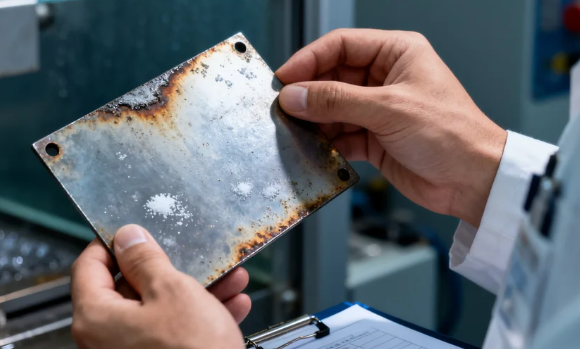
- Type and distribution of corrosion products (red rust, white rust, base metal corrosion)
- Corrosion area or number of pits (%)
- Corrosion grading per GB/T 6461 and related standards
| Material/Coating Type | Test Method | Typical Duration | Acceptance Criteria |
|---|---|---|---|
| Standard Zinc Plating | NSS | 24–72 h | No red rust, white rust <5% |
| Nickel–Chrome Decorative Plating | CASS | 16–24 h | No pitting, no substrate corrosion |
| Anodized Aluminum | AASS | 24–48 h | Pitting grade ≤ 8 |
| Industrial Coatings | NSS | 240–1000 h | Creep from scribe ≤1 mm |
Example:
An automotive manufacturer compared 500-hour NSS results from two suppliers and found that supplier A’s zinc plating lasted 2.5× longer than supplier B’s.
Old vs New Salt Spray Test
GB/T 10125-2021, based on ISO 9227:2017, revises and expands upon the 2012 edition. The key technical changes include:
Expansion of Test Types
The 2021 version clearly includes AASS and CASS test methods and specifies situations where the test is not applicable, helping users select the proper salt spray test for their material.
Optimization of Test Solutions and Equipment Requirements
- Solution purity improvement: Total heavy metal impurities < 0.005%, water conductivity ≤ 20 μS/cm.
- Specimen rack materials: Must use inert materials like glass or plastic to avoid galvanic corrosion.
- Equipment control upgrades: Chamber volume ≥ 0.4 m³, equipped with exhaust and waste treatment systems, spray pressure 98 kPa ± 10 kPa.
- Reference sample validation: Introduces CR4-grade cold-rolled steel reference specimens to verify chamber performance.
| Item | GB/T 10125-2012 | GB/T 10125-2021 | Significance |
|---|---|---|---|
| Test Types | No clear AASS or CASS scope | Covers all three methods | Guides proper test selection |
| Solution Purity | No quantitative limit | Heavy metal impurities <0.005% | Improves repeatability |
| Specimen Rack | No material requirement | Specifies inert materials | Eliminates interference |
| Equipment Requirements | Basic functions only | Detailed and eco-friendly design | Ensures consistency |
Example:
A plating factory adjusted its CASS testing process under the new standard and used reference specimens to verify chamber performance, greatly improving product quality consistency.
NSS vs AASS vs CASS Salt Spray Test, What’s the Difference
| Test Type | Solution Composition | Temperature | pH | Relative Severity | Typical Application |
|---|---|---|---|---|---|
| NSS | 5% NaCl | 35°C | 6.5–7.2 | Mild | General metals, zinc plating, paints |
| AASS | 5% NaCl + Acetic Acid | 35°C | 3.1–3.3 | Moderate | Anodized aluminum, decorative coatings |
| CASS | 5% NaCl + Acetic Acid + CuCl₂ | 50°C | 3.1–3.3 | Severe | Decorative Cu–Ni–Cr plating, high-end coatings |
Which Test Should You Choose?
- Use NSS for general corrosion testing of protective coatings or to compare different paint systems.
- Use AASS for anodized aluminum or decorative finishes requiring moderate corrosion resistance.
- Use CASS when testing decorative electroplated parts or coatings that must withstand harsh, high-humidity, or marine-like conditions.
Each test provides valuable insight into how a coating or metal will perform in service — but keep in mind that salt spray testing does not directly predict real-world lifespan. It’s best used for comparative evaluation and quality control, not lifetime estimation.